

It’s a busy day at Bisi’s Studio in Lagos. What started as a side hustle, making and selling outfits to her friends attending weekend weddings, is now a blossoming business after a custom design went viral. But instead of designing her next collection, Bisi spends half her day collecting and tracking payments.
Once a customer agrees to a sale via Instagram DM, Bisi sends her account number and waits for proof of payment. Only after manually verifying the funds in her banking app does she dispatch a delivery rider. She dreams of scaling to an upmarket studio, but the daily friction of getting paid holds her back.
This payment acceptance gap is the reality for most of Sub-Saharan Africa’s 44 million MSMEs. Data shows only 35% of payments received by Sub-Saharan African MSMEs are digital.
The Mismatch Between Traditional Payment Gateways and Local Reality
If consumers are moving trillions in digital payments, why is accepting payments so difficult for Bisi?
The core issue is a fundamental mismatch between how traditional payment gateways work and how African businesses actually operate. Most global payment infrastructure assumes the merchant has a fully functioning e-commerce website, but in Africa, e-commerce looks very different.
A majority of African MSMEs sell exclusively through social media and chat apps. WhatsApp and Instagram aren’t just marketing channels; they are the storefront, the negotiation table, and the checkout counter all rolled into one.
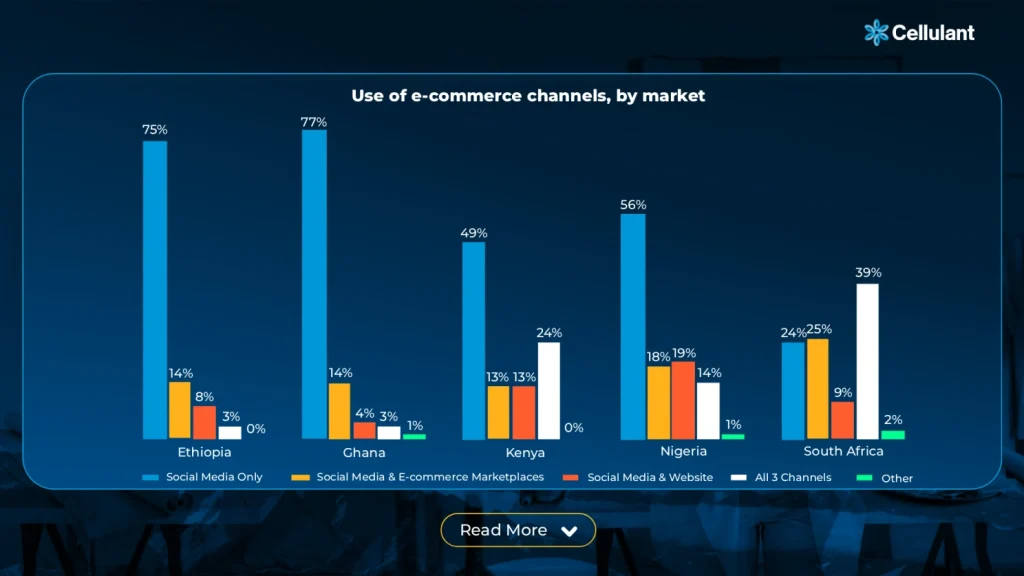
Use of e-commerce channels by market, adapted from GSMA
The Hidden Flaws of Standard Plug-and-Play Payment Solutions
To accommodate customers paying via card, bank transfer, or mobile money, merchants like Bisi end up juggling multiple bank accounts and dedicated SIMs. Merchants may look for plug-and-play payment solutions, but these tools quickly run into their own problems.
Many solutions still default to cards as a single payment option, while large parts of Africa prefer different payment methods like mobile money. There are also complicated regulatory requirements to contend with, not to mention clunky interfaces that easily time out on 3G connections.
Even worse is the impact on cash flow. If a payment solution traps Bisi’s working capital in a delayed settlement queue, she can’t pay her suppliers and will inevitably abandon it in favour of her old manual system.
Bigger Budgets Don’t Automatically Solve the Acceptance Gap
Bisi’s daily struggle with payments is simply the micro version of what scaling enterprises and financial institutions face on a macro scale. It is two sides of the same coin: Africa’s payment ecosystem is deeply fragmented, and navigating it demands enormous resources.
When larger merchants try to solve this fragmentation by building their own custom cross-border payment integrations, they immediately hit a financial and operational wall. Building bespoke payment infrastructure internally can take at least 12 to 18 months and require $250,000 to $1 million in upfront capital. Every expansion into a new country resets the clock, requiring another three to six months for integration and new compliance approvals.
How To Fix The Acceptance Gap Without The Burden.
This is where Cellulant changes the equation by allowing businesses of all sizes to plug into a network that has already done the hard work.
For Bisi, Cellulant removes the technical barrier completely with no-code solutions like Tingg EasyPay, which lets her initiate a payment and send a direct payment link to her customers, or Tingg Payment Pages, which gives her a branded payment page she can drop directly into her Instagram chats.
Her customer pays via instant transfer, mobile money, or card. Everything is instantly reconciled on a single dashboard. Bisi finally has the verifiable digital ledger she needs to secure a bank loan and scale into a more upmarket area.
These no-code tools aren’t just for solo founders. Scaling enterprises can use these same solutions to bypass months of development, launching digital collections instantly while their engineering teams focus on core products.
When those enterprises are ready for deeper infrastructure, a single API integration handles the rest. All the heavy lifting happens quietly in the background, replacing a six-figure engineering nightmare with one seamless connection.
Scaling a business in Africa shouldn’t require you to become a payments company by accident. Cellulant provides a single point of access to the continent’s fragmented payment ecosystem, whether through a simple no-code link in a chat window or a deep API integration. It abstracts the complexity entirely so you can put your full weight behind what actually differentiates your business.