



It’s month-end, and a bank’s operations team has to manually reconcile settlement reports from six different African countries because their systems don’t talk to each other. Across town, an insurance claimant is still waiting a week later for a payout because there’s no automated way to disburse funds to their mobile wallet. Past the city’s edge, a microfinance officer travels in person to collect a cash payment from a member using a basic feature phone.
Three very different organisations, one shared obstacle: trying to operate within Africa’s fragmented payment ecosystem.
The Post-P2P Infrastructure Gap
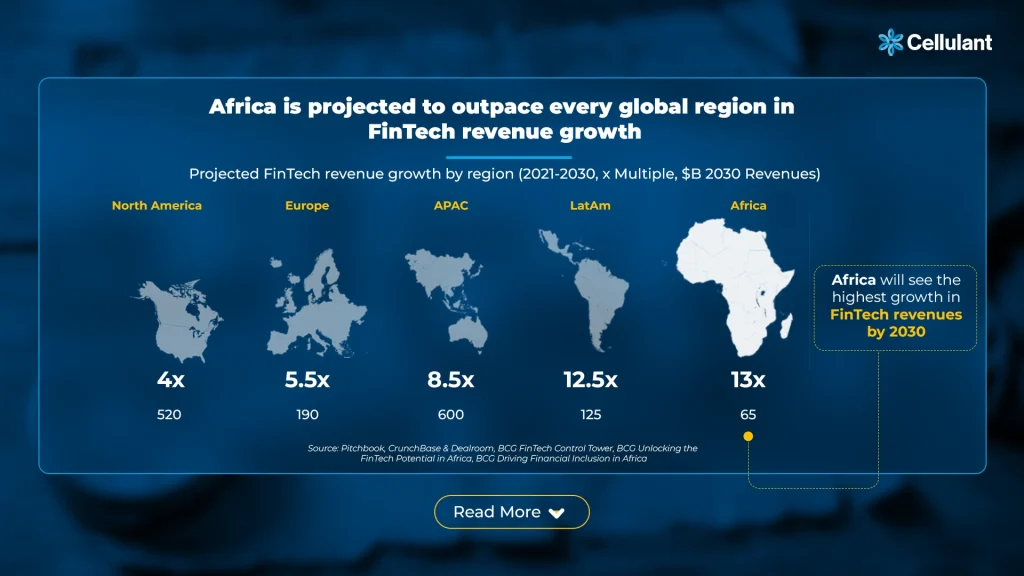
African fintech revenue is projected to increase thirteen-fold by 2030, reaching $65 billion, the highest growth multiple of any region in the world.
Much of Africa’s fintech story so far has been driven by peer-to-peer payments. Mobile money and digital wallets have brought millions of people into the formal financial system, creating new possibilities for how people save, borrow, insure, pay and transact.
But the next phase of growth looks different. The next decade belongs to institutional financial services and enabling them to build and scale increasingly sophisticated services across the continent.
That means banks collecting payments across markets. Insurers collecting premiums and paying claims digitally. Microfinance institutions disbursing loans and collecting repayments wherever their customers are. Financial institutions expanding into new countries without having to rebuild their payment infrastructure every time.
It is an enormous $65B opportunity! But realising it means scaling institutional payments across Africa, which are recurring, heavily regulated, cross-border, and demand real-time reconciliation.
The self-defeating scale paradox
For institutional payments, transactions are recurring rather than occasional, and run at high volumes. Reconciliation becomes more complex. Regulatory obligations become heavier. Payments need to move across borders, currencies, banks, mobile wallets and other channels.
And the moment a financial institution expands beyond its home market, the complexity multiplies.
Payment methods vary from country to country. Settlement cycles differ. Account validation works differently. Licensing, data residency, AML requirements and exchange controls all have to be considered market by market.
What looks like a simple requirement, “collect a payment from a customer”, can quickly become a web of integrations across switches, telcos, banks, wallets and card networks.
And trying to build these capabilities in-house across multiple markets quickly becomes an operational nightmare. Instead of building core products, your engineering team spends half its time just keeping custom payment connections alive.
The result is an uncomfortable paradox:
The more an institution wants to grow across Africa, the more time and resources it can end up spending maintaining the infrastructure it needs to grow.
Spend less time maintaining connections. More time creating growth.
But payment connectivity is rarely what differentiates a bank, insurer or lender.
The competitive question isn’t who connects to the most payment rails. It is who can build better financial products, reach more customers and get into areas everyone else finds too hard to serve.
Instead of maintaining a web of individual connections, a financial institution can connect once to an infrastructure provider that abstracts the complexity of the underlying payment ecosystem — gaining access to multiple payment methods, markets and channels, while the operational complexity of navigating each one sits behind the integration.
The result isn’t simply fewer integrations. It’s more room to build.
This is the role Cellulant plays.
Cellulant provides a connectivity layer between financial institutions and Africa’s payment ecosystem, giving institutions access to collections and disbursements across markets.
With one single integration, you unlock a pan-African network of mobile money, cards, banks, and wallets, with regulatory compliance and licensing already baked in.
For a bank, it means collecting and paying out across borders and across every channel a customer might use, with centralised visibility rather than reports from multiple systems.
Insurers get the full premium arriving with the surcharge visible to the client at the point of payment, claims disbursed straight to the customer’s wallet, and a policyholder able to raise a claim over WhatsApp instead of waiting in a call centre queue.
Microfinance institutions can onboard a member, disburse a loan, collect a repayment, and reconcile all of it wherever that member happens to be, including on a basic handset, allowing them to reach a substantial share of the continent’s underserved customers.
The value of this model isn’t simply technical efficiency; it’s growth and differentiation. It changes where an institution can put its resources, freeing teams to focus on the products and markets that set them apart, rather than the infrastructure that gets them there.
Africa’s $65 billion opportunity won’t be realised by the institutions that treat fragmentation as a DIY engineering project. It’ll be captured by those who build what actually differentiates them without having to rebuild the rails beneath them.
Partner with Cellulant today. One integration. Multiple markets. Multiple payment rails. More room to build what differentiates you.