


Intra-African trade rose to an estimated US$220.3 billion in 2024, but it is still hampered by deep structural issues that punish both large enterprises and MSMEs, like Nairobi Print and Packaging (NPP)*, a mid-sized B2B printing firm in Kenya.
NPP supplies a large Nigerian consumer goods manufacturer with specialised packaging components. Sarah, NPP’s financial manager, is in charge of this supply relationship.
To ensure seamless business operations, Sarah expects payment every Monday to cover the week’s raw material costs and payroll. The relationship is becoming strained because the disbursements initiated in Nigeria have been unreliable. From their end, the Nigerian client is initiating their payments on time, but the process of routing the funds to NPP can take up to 5 business days, delaying payroll and supply payments.
Sara says, “This situation impacts NPP’s team morale, because staff salaries can often not be released on time. Even worse, we often receive KES 100,000 less than expected due to hidden fees and unfavourable exchange rates charged by the intermediary banks. This is a massive drag on our cash flow and relationship with this client.”
Sarah’s and NPP’s struggle is one of many that illustrate the urgent need to move past fragmented, costly legacy systems toward truly unified B2B financial infrastructure for high-value, recurring, and compliant cross-border disbursements between African Enterprises.
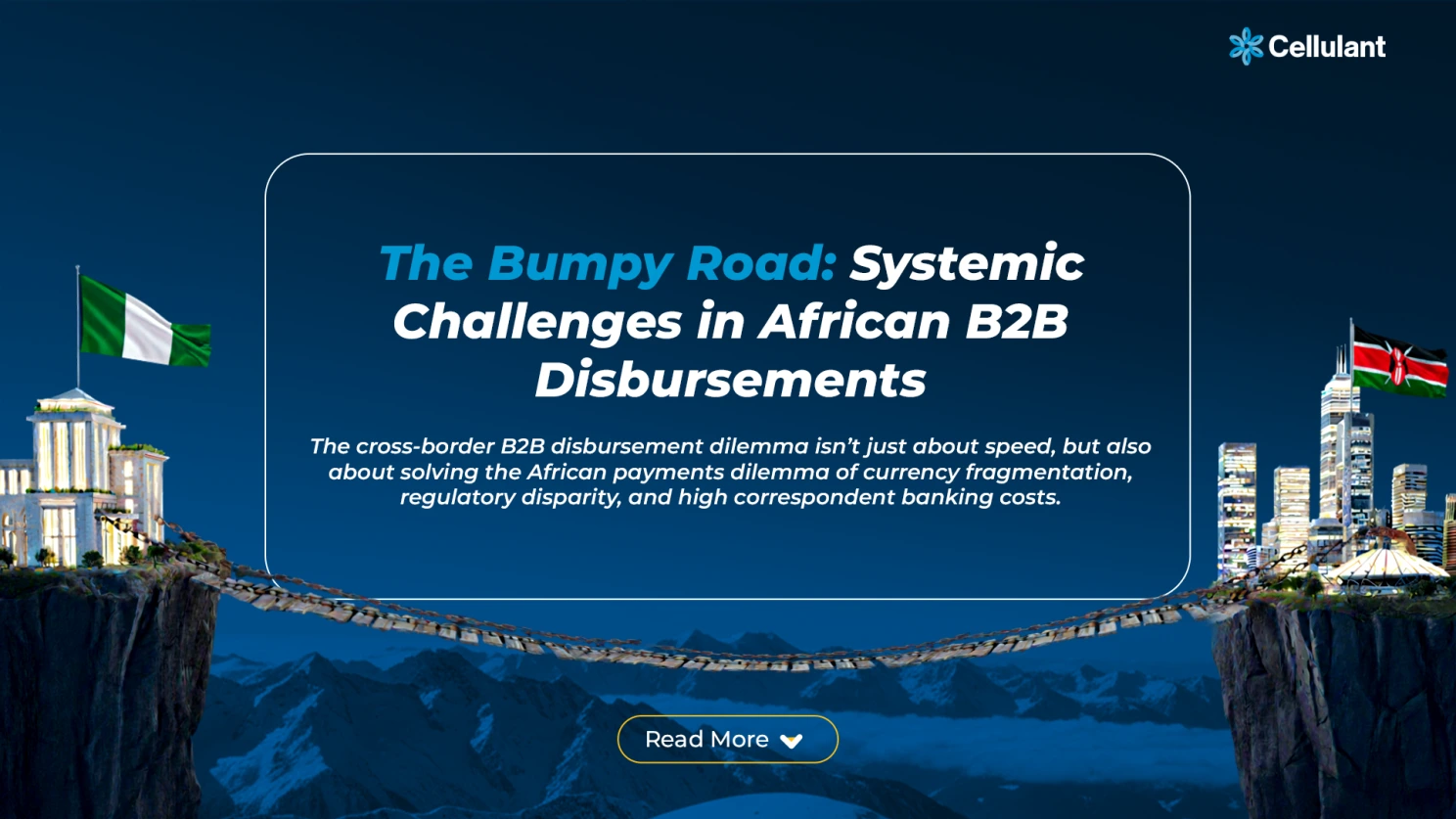
When the Nigerian client initiates Sarah’s weekly transfer, the payment sets off on a complicated journey that crosses currencies, borders, and banking systems. This is a slow and expensive process.
First, Sarah requires payment in Kenyan shillings to pay wages and local suppliers. The Nigerian naira (NGN) and Kenyan shilling (KES) do not have a direct, liquid trading pair. Therefore, the client’s corporate bank first needs to convert NGN into a tradeable currency, usually US dollars. The NGN exchange rate fluctuates daily, and often the official rate used by banks is very different from the market rate people actually get. By the time the conversion is done, the payment might already be worth a few per cent less than when it started.
Once converted into USD, the funds pass through a chain of correspondent banks, often in London or New York, because many African banks lack direct relationships to move money. Each stop along the way adds its own small fees and processing delays, and neither Sarah nor her client can easily see where the money is in real time.
When the USD funds finally reach NPP’s account, they need to be converted into KES, once again exposing it to currency volatility and delays.
Every African country runs its own financial system with different central bank regulations, foreign-exchange controls, and anti-money-laundering checks. The systems themselves also work differently, and the technical messaging formats between banks aren’t always compatible.
This means even if the payment looks fine in Nigeria, it might still trigger a compliance review or data mismatch in Kenya. Sometimes, a missing tax ID, a mismatched invoice number, or a wrong purpose code is enough to hold up the payment for another day or two while both banks double-check the paperwork.
What should have been a straightforward transaction between two African businesses ends up feeling like an international obstacle course.
Paving the way for seamless cross-border payments
Africa doesn’t lack talent or opportunity; it lacks connection. Until businesses can move money across borders as easily as they exchange ideas, the continent’s full potential will stay locked behind outdated systems.
Sarah’s experience captures what many African businesses face every day. Every delay, every hidden fee, and every lost shilling reflects value drained from the continent’s own economies.
The African Continental Free Trade Area (AfCFTA) is making great strides to enable the free flow of goods and services across the continent by eliminating trade barriers. For Africa to unlock the promise of the AfCFTA, money must move as freely as goods and ideas.
Cellulant Payouts provides the financial technology that connects businesses to intra-African opportunities, bridging the gap between fragmented banking systems and real-time commerce.
Instead of the multi-step conversion from naira to dollar and then to shillings, Cellulant enables direct local-currency settlement, eliminating hidden FX spreads and double conversions.
Where payments once disappeared into a maze of correspondent banks, Cellulant moves funds directly between verified networks, cutting settlement from days to minutes and eliminating the silent deductions that erode business relationships.
Our integrations with local regulators and financial institutions do the heavy lifting of KYC and AML to keep every transaction aligned from source to destination.
By providing a single, seamless connection via API or web platform, Cellulant lets enterprises send and receive cross-border payments without losing value or time.
With unified infrastructure like ours, African enterprises can finally trade on equal footing: faster settlements, predictable cash flow, and transparent pricing that keeps more value within the continent. The result is so much more than smooth payments, but also the foundation for a connected African economy, where trust, speed, and innovation drive progress across borders.
*Fictional company